Party Types
Start from the kind of event you are actually running
A first birthday and a school fete need almost nothing in common. Six event types, each with its own planning shape, its own timing and its own list of what is worth booking.
Most party advice starts from the entertainment. Starting from the event is more useful, because the event decides the guest list, the length, the venue and the budget, and those four decide the entertainment rather than the other way around.
A first birthday is a two hour daytime event where the real guests are adults. A nine year old's party is ninety minutes of high energy with parents dropping off. A school fete runs for four hours with a queue that never empties. Each one wants a different booking.
Pick the event below and the page will tell you what shape it usually takes and what is worth spending on.
Browse
Every party types option
Each one has its own page with the detail, the buyer questions and the planning notes that actually differ.
Kids Birthday Parties
The classic backyard or hall party for ages three to twelve.
Explore1st Birthday Parties
Soft play, ball pits and pastel styling built for babies.
ExploreToddler Birthday Parties
Short, gentle entertainment for one to three year olds.
ExploreSchool and Preschool Events
Incursions, fetes and end of year celebrations.
ExploreFamily Fun Days
Community and club days with several activity stations.
ExploreCorporate Kids Events
Family days and staff events with the kids side handled.
ExploreCompare
Six event types at a glance
Typical shapes rather than rules. Every family runs these differently.
| Event | Usual length | Who is really there | What matters most |
|---|---|---|---|
| Kids birthday parties | 2 hours | Children, parents dropping off | One strong entertainment block |
| 1st birthday parties | 2 hours | Adults, with babies attached | Somewhere safe to put the babies down |
| Toddler birthday parties | 2 hours | Toddlers and their parents | Timing around the nap |
| School and preschool events | 1 to 4 hours | Large groups, staff supervising | Insurance certificates and paperwork |
| Family fun days | 3 to 5 hours | Whole families, rolling attendance | Several stations, not one show |
| Corporate kids events | 2 to 4 hours | Staff families, mixed ages | A separate kids zone that runs itself |
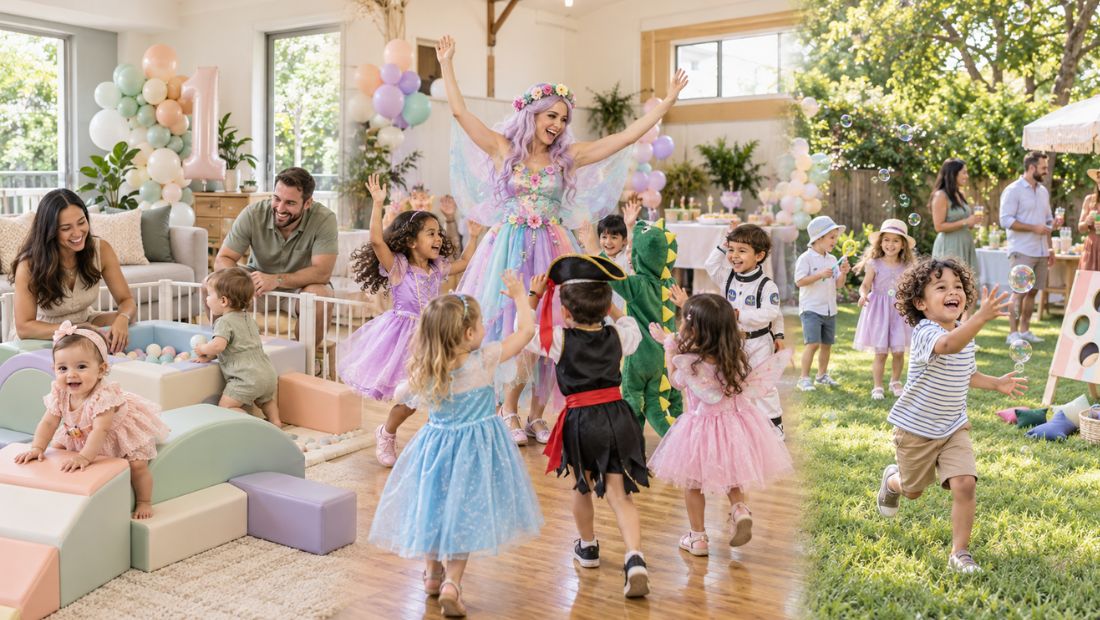
The pattern behind all of them
Rolling attendance or a fixed audience changes everything
It is the single most useful distinction in event planning and almost nobody makes it explicitly.
Common questions
Party type questions
How long should a kids party be?
Two hours for most birthdays. Ninety minutes for three and four year olds, who run out of stamina before you run out of party. Fetes and fun days run three to five hours because the crowd turns over rather than staying.
What is different about a school or preschool event?
The paperwork. Schools will want the supplier's public liability certificate, often a Working with Children Check, and sometimes a risk assessment. Allow more lead time than a home party needs. See school and preschool events.
Do I need different entertainment for a fun day?
Yes. Anything that performs once reaches only the people standing there at the time. Carnival stalls, giant games, face painting and balloon twisting all work because the queue keeps reforming through the afternoon.
Can one supplier cover a mixed age event?
Sometimes, but usually you want two things running. Something contained for the under fives and something active for the older children. Say the age spread in your brief and quotes come back sized for it.
What is the best age to start booking entertainment?
Around three. Under three, play hire does more than a performer can. From three, an entertainer starts to earn their fee. See the age and suitability guide.
Tell us about the party once
One brief, matched to suppliers who cover your suburb and are free on your date. Free for parents, with no obligation to book.